How to build a 2027 real estate recruiting plan: Q3 webinar recap
Key points: building a real estate recruiting plan for 2027
- Net recruiting gains at the top 100 brokerage brands fell 57% from January to September 2026 vs. 2025, according to Courted's State of Recruiting & Retention data.
- Recruiting cooled faster than attrition: volume recruited fell 31% and volume lost fell 24%; the net growth rate slipped from 2.5% to 1.0%.
- Retention improved: 73 of 95 brands in the top 100 both years lost a smaller share of their volume, and median attrition fell from 6.3% to 4.7%.
- A 2027 recruiting plan starts with a net goal that adds expected departures to your growth target, then a pipeline sized to hit it.
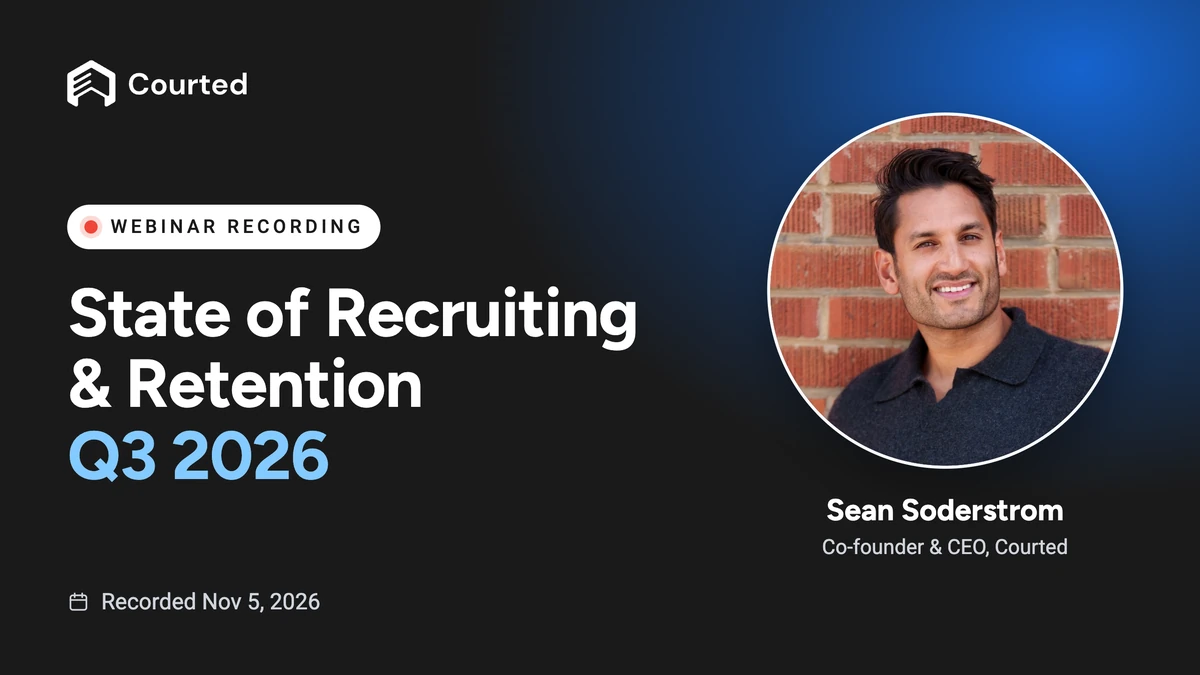
A 2027 real estate recruiting plan should start from what changed in 2026: less production changed brokerages, so growth has to come from winning share. In Courted's Q3 2026 State of Recruiting & Retention webinar, co-founder and CEO Sean Soderstrom walked through the data and a six-step plan for growing net production next year.
This recap answers the main questions the webinar covered, using Courted's data on the top 100 brokerage brands by sales volume. The full recording is below.
What are the biggest real estate recruiting trends in 2026?
Recruiting slowed far more than the industry expected, while retention improved. In an October 2026 LinkedIn poll by Sean Soderstrom, 69% of respondents expected the top 100 brands' net recruiting gains to hold steady or grow. Instead, net volume gained through recruiting fell 57%, from $56.6 billion to $24.3 billion.
- Recruiting cooled the most. The recruiting rate fell from 11.4% to 7.2% of annual brand volume, and volume recruited fell 31%, from $257.1 billion to $176.6 billion.
- Attrition fell too, but by less. The attrition rate fell from 8.9% to 6.2%, and volume lost fell 24%, from $200.5 billion to $152.3 billion.
- Fewer brands are growing. 68 of the top 100 brands grew net volume, down from 81, and the median brand's net growth rate fell from 3.0% to 1.3%.
- Mid-size brands grew fastest. Brands 26 to 50 by sales volume grew 2.72% and brands 51 to 100 grew 2.30%. The 10 largest brands grew 0.69%, and brands 11 to 25 slowed the most, from 4.05% to 0.90%.
For the full breakdown, see real estate recruiting trends in 2026: expectations vs. reality.
Are fewer real estate agents switching brokerages?
Less production is changing brokerages. The top 100 brands recruited 31% less volume from January to September 2026 than in the same months of 2025, and lost 24% less. Courted's report compares sales volume rather than agent counts, because 2026 recruit counts aren't directly comparable with 2025.
With fewer agents moving, any agent who leaves is harder to replace. The agents who do move still have reasons to, and those reasons are what a recruiting pitch has to answer. For what drives them, see why real estate agents switch brokerages.
Why do recruiting and retention matter more in a slow market?
When home sales are slow, the market won't lift a brokerage's volume, so net recruiting is how it grows. The National Association of REALTORS® (NAR) reported existing-home sales at a 3.99 million pace in September 2026.
Recruiting was already a top concern before the slowdown. In a spring 2025 Inman Intel survey of brokerage leaders, 42% named recruiting and retention their top challenge. The webinar drew three conclusions for 2026:
- Growth has to come from share. The market won't lift your volume. Net recruiting is how you grow.
- Brokerages must recruit proactively. Agents won't move on their own. Production recruited by the top 100 fell 31% year to date.
- Every agent you keep counts more. A departure is production you have to win back, with fewer agents moving.
What to do in Q4
- Recruit for net production, not headcount. Track who you're recruiting and who you're losing in one place, and measure the difference.
- Focus on the agents most likely to move. With less production moving, time spent on the right conversations matters more.
- Reach out with something personalized. A message built on an agent's own production gives them a reason to reply.
How do you build a real estate recruiting plan for 2027?
Build the plan from a net goal, not a headcount goal, then size your pipeline and daily routine to hit it. The webinar laid out six steps:
- Set a net recruiting goal for 2027. Add expected departures to your growth target. The median top 100 brand lost 4.7% of its volume from January to September 2026.
- Recruit the agents who fit your model. Mid-tier producers are often the most profitable, and they're the bulk of the volume that moves each year.
- Build your funnel and manage to it. Ten recruits a year at a 3% conversion rate means about 330 agents in your pipeline, or about 28 new ones a month. Hold yourself and your managers accountable to that number. Here's more on treating recruiting as a sales funnel.
- Make recruiting a daily habit. The 3/3/3 rule is a simple routine: three new contacts, three pipeline follow-ups and three retention check-ins a day, in under 30 minutes.
- Consider different compensation options. See how your offers compare with caps, flat fees and 100% models, and price on an agent's likely future production. Offering more than one option improves recruiting conversion and retention. Here's how to recruit real estate agents without raising splits.
- Use systems that generate a return. Recruiting and retention software should be foundational to your tech stack, judged by the net production it helps you recruit and keep. Courted averages 17.6x ROI across the 1,000+ brokerages it works with today.
For the recruiting process itself, step by step, see how to recruit real estate agents in five steps.
How can brokerages keep more of their agents in 2027?
Make retention its own priority, not part of recruiting. Helping every agent close one more deal compounds growth. The data shows why it matters: the quarter of top 100 brands that recruited the most lost 10.0% of their volume to departures, 2.8 times the 3.6% lost by the quarter that recruited the least. A year earlier, the gap was 2.0 times.
- Help agents win more listings. Give them market data they can use in competitive listing presentations.
- Automate the admin. Celebration and coaching triggers handle the reminders, so leaders can focus on relationships and personalized support.
For why productivity matters more than splits, see 60% of a watermelon vs. 99% of a grape.
What should brokerage leaders look for in recruiting software?
Look for software that ties recruiting and retention to net production and makes the daily work faster. The capabilities the webinar called out map to the plan above:
- One place to track recruiting and departures. See who you're recruiting and who you're losing side by side, so you can manage to a net goal.
- Signals on who may move. Potential-to-move signals on every agent in your market, built from MLS data, point managers to the right conversations.
- Personalized outreach. Drafts based on each agent's production make the first message specific.
- Retention triggers. Celebration and coaching prompts for your own agents, so no milestone slips by.
Courted Talent Solutions does each of these for brokerages. For a fuller buying guide, see how to choose real estate recruiting software.
Book a demo to see which agents in your market show potential to move.
Frequently asked questions
How much did real estate recruiting slow in 2026?
Net recruiting gains at the top 100 brokerage brands fell 57% from January to September 2026, to $24.3 billion from $56.6 billion in the same months of 2025, according to Courted's State of Recruiting & Retention data. Volume recruited fell 31% and volume lost fell 24%, so the net growth rate slipped from 2.5% to 1.0% of annual volume.
What is a net recruiting goal?
A net recruiting goal is the production a brokerage wants to add after departures. To set one, add the volume you expect to lose to your growth target. For reference, the median top 100 brokerage brand lost 4.7% of its annual volume to departures from January to September 2026, according to Courted's data.
What is the 3/3/3 rule for real estate recruiting?
The 3/3/3 rule is a daily recruiting and retention routine: three new contacts, three follow-ups with agents already in your pipeline and three check-ins with your own agents. It takes under 30 minutes a day. It was part of the 2027 recruiting plan in Courted's Q3 2026 State of Recruiting & Retention webinar.
How many agents should be in a brokerage's recruiting pipeline?
Work backward from your recruiting goal and your conversion rate. A brokerage that wants 10 recruits a year and converts 3% of the agents it works needs about 330 agents in its pipeline, or about 28 new agents a month. Hold yourself and your managers accountable to that number.
Is agent retention getting better in 2026?
Yes. Across the top 100 brokerage brands, the attrition rate fell from 8.9% to 6.2% of annual volume from January to September 2026, compared with the same months of 2025. Of 95 brands in the top 100 both years, 73 lost a smaller share of their volume, and the median brand's attrition rate fell from 6.3% to 4.7%.
Get your brokerage ready to recruit in 2027
Less production is moving, so every recruit and every agent you keep counts for more next year. Book a demo to see the agents in your market most likely to move, and how Courted helps your managers work them.
About the data: Courted's State of Recruiting & Retention compares January to September 2026 with the same months of 2025 for the top 100 brokerage brands by sales volume in each period. Volume recruited and lost is the sales volume of agents who joined or left each brand. Rates divide that volume by the brand's annual sales volume, so they adjust for size. July to September figures may be revised as late moves are recorded.