How to keep agents from leaving your brokerage: 6 warning signs to act on
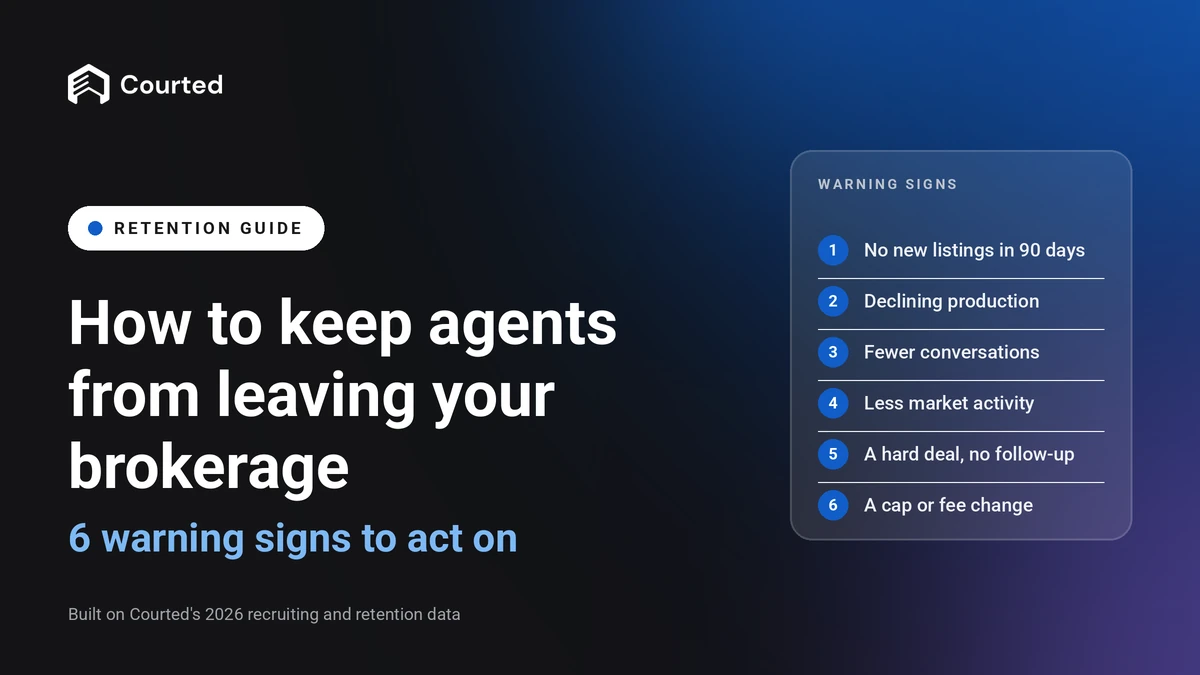
Key points: how to keep agents from leaving your brokerage
- Retention is one of the top initiatives for brokerages of all sizes. Agents almost never announce they are leaving until it’s too late to keep them.
- Retention improved in 2026: 73 of the 95 brands in the top 100 both years lost a smaller share of their production to departing agents, according to Courted's data.
- Agents who had just moved told Courted that belonging, leadership and support mattered as much as pay, or more.
- Warning signs like no new listings in 90 days, declining production and fewer conversations usually show up before an agent leaves.
To keep agents from leaving your brokerage, watch for the early signs that an agent is drifting and reach out before they start taking calls from other brokerages. Ask what's missing, fix what you can, and show them what they'd give up by moving. A counteroffer after an agent resigns is the most expensive way to keep an agent.
Agents rarely leave on a whim. They leave when something they need is missing, and that usually shows up in their business and their behavior first, making it addressable.
Why does agent retention matter in 2026?
Retention matters more than ever because recruiting slowed in 2026. From January to September 2026, the top 100 brokerage brands netted $24.3 billion in production through recruiting, down 57% from the same months of 2025, according to Courted's 2026 recruiting and retention data. With less production changing hands, every agent you keep is production you don't have to replace. It's also a top concern: in a recent Inman Intel survey of brokerage leaders, 42% named recruiting and retention their top challenge.
The brokerages that kept the most did better than the ones that recruited the most. The quarter of brands with the highest recruiting rates lost 10.0% of their volume to departures, 2.8 times the 3.6% lost by the quarter that recruited least. After departures, the heaviest recruiters kept about 31 cents of every dollar of production they recruited.
There's good news, too. Of the 95 brands in the top 100 both years, 73 lost a smaller share of their production to departing agents than a year earlier, and the median brand's attrition rate fell from 6.3% to 4.7% of its annual sales volume. Fewer firms see retention as their biggest problem: 18% of firms named it their top challenge for the next two years in the National Association of REALTORS® (NAR) 2025 Profile of Real Estate Firms, down from 22% in 2023, according to NAR's analysis.
Why do agents leave their brokerage?
Agents leave when something important is missing. In Courted's interviews with experienced agents who had just moved, the six main reasons were:
- They didn't feel they belonged. Agents described feeling like “just a number” at their old brokerage.
- Their manager or broker was out of reach. Leadership they rarely heard from, or couldn't reach when it mattered.
- No one was in their corner when a deal went sideways. Feeling unsupported in a hard moment pushed agents out.
- They stopped growing. Agents who felt stagnant or undervalued looked elsewhere.
- They were paying for things they didn't use. Higher caps and fees for an office or services they never touched.
- Tech became a burden. Too many tools, or tools with gaps.
Pay and splits matter too, but in many cases belonging, leadership and support mattered as much or more. Here's more on why real estate agents switch brokerages.
What are the warning signs an agent may leave?
The warning signs an agent may leave show up in their production and their behavior before they resign. None of them means an agent is leaving. Each one is a reason to check in.
- No new listings in 90 days. A gap in listings is one of the earliest signs that an agent's business, or attention, is shifting.
- Declining production. Watch for production falling against the agent's own track record and against peers in the same market.
- Fewer conversations. Slower replies, skipped meetings and less consistent contact with their manager.
- Reduced market activity. Less activity overall than the agent's usual pace.
- A hard deal with no follow-up. A deal that fell apart or a difficult client, and no one checked in afterward.
- A change in what they pay or get. A cap or fee increase, a lost team leader, or a change in office support.
Most brokerages catch these signs too late. By the time an agent says they're talking to another brokerage, the relationship has sometimes weakened beyond repair.
What should you do when you spot a warning sign?
When you spot a warning sign, call the agent within the week and ask how their business is going before you ask anything else. The goal is to learn what's missing while there's still time to fix it.
- Call, don't email. A short conversation tells you more than a survey, and it shows the agent someone is paying attention.
- Ask what's missing. Use the six reasons above as your guide: belonging, access to leadership, support, growth, value for what they pay, and tools that help.
- Fix what you can, quickly. An introduction, a coaching session, help on a stuck deal or a change to a fee that no longer makes sense.
- Make the case for staying. Remind them of the practical and personal value they'd give up by moving.
- Don't lead with a better split. A richer split can keep an agent for a year while the real problem stays. Here's how to recruit and keep agents without raising splits.
- Log it and follow up. Note what you heard and set a reminder to check in again.
Courted Talent Solutions flags agents who may be at risk of leaving, based on signals like production against their peers and market and competitive factors, so managers know who to call. It also flags milestones worth recognizing and drafts messages for managers to review and send. Book a demo to see which of your agents may need a call this week.
How to keep agents from leaving your brokerage before problems start
Keep agents from wanting to leave by building small habits your leaders repeat every day, so agents feel seen long before anything goes wrong. Retention is usually a consistency problem, not a motivation problem.
- Recognize wins. Congratulate an agent on a new listing or a strong month. A thirty-second text tells them someone noticed.
- Make leaders visible. Open doors, quick feedback and managers agents can actually reach.
- Show up for the hard moments. A check-in after a difficult transaction costs little and is remembered.
- Help agents grow. Coaching, career paths and support that help agents close more business.
- Build a daily routine. Try the 3-3-3 routine: three new recruiting contacts, three follow-ups and three retention check-ins a day. Here's how nine conversations a day can transform your brokerage.
- Offer something agents can't get elsewhere. Splits and tools can be matched. Ownership, a network, a brand with real customer pull or strong local leadership are harder to copy.
For more on the daily habits, see how to retain real estate agents.
Frequently asked questions
How do I keep agents from leaving my brokerage?
Watch for early warning signs, like no new listings in 90 days, declining production or fewer conversations, and call the agent when you see one. Ask what's missing and fix what you can. Day to day, recognize wins, keep leaders reachable and support agents through hard deals. Agents who had just moved told Courted that belonging, leadership and support mattered as much as pay, or more.
What are the first signs an agent may leave?
Common early signs are no new listings in 90 days, production falling against the agent's own track record or their peers, fewer conversations with their manager, and less market activity. A hard deal with no follow-up, or a cap or fee increase, can also prompt an agent to look around. None of these means an agent is leaving; each is a reason to check in.
Should I offer a better split to keep an agent?
Lead with the conversation, not the split. A richer split can buy time without fixing what made the agent unhappy, and it sets a precedent other agents may ask about. Find out what's missing first. If compensation really is the issue, model what a change would cost before you offer it.
How often should managers check in with agents?
Build check-ins into every day instead of saving them for quarterly reviews. A simple routine is three retention check-ins a day alongside recruiting calls and follow-ups. Prioritize agents with a warning sign, a recent milestone or a recent hard deal, so the time goes where it matters most.
Can software tell which agents are going to leave?
Software can flag agents who may be at risk, based on signals like changes in production, listing activity and market factors. Those signals point to potential risk, not certainty, so they tell managers who to call first. The conversation is still what keeps the agent.
Methodology
Figures on recruiting and attrition come from Courted's data on the sales volume of agents who joined or left each of the top 100 brokerage brands by sales volume, January to September 2026 compared with the same months of 2025. Reasons agents leave come from Courted's interviews with experienced agents who had recently changed brokerages.
Keep the agents you have
The brokerages that grow fastest are the ones that keep what they recruit. Find the agents who may be drifting, call them first and give them a reason to stay.